Welcome to the

Research

Overview

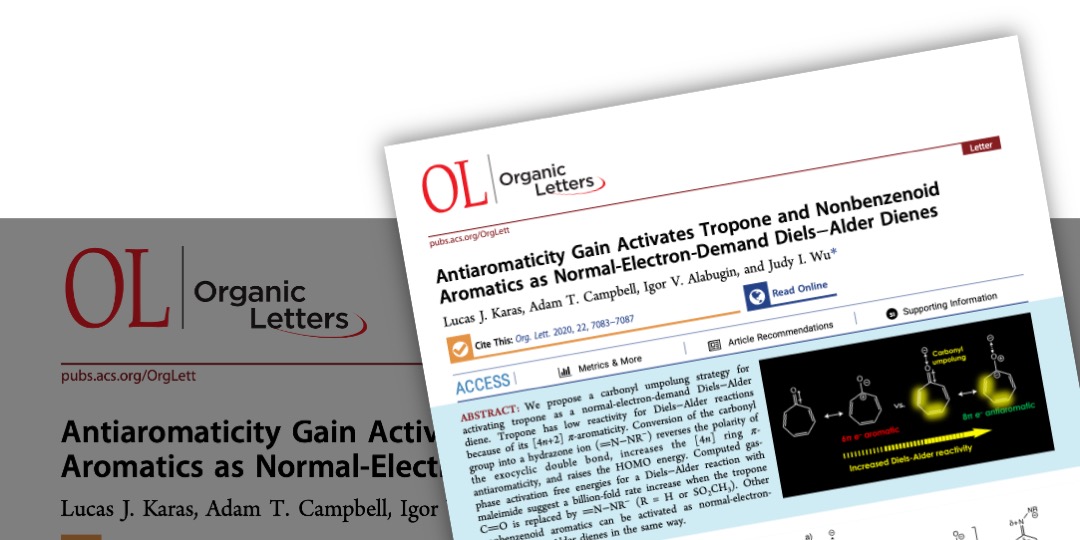
We are a computational physical organic chemistry group at the University of Houston. We pursue the whys and what-ifs that underlie molecular properties and chemical reactivity. Some days we are organic chemists, and other days we are photochemists or supramolecular chemists. Our current interests include molecular photoswitches, carbon-rich polycyclic (anti)aromatic hydrocarbons, the design and control of photochemical reactions, and self-assembling hydrogen-bonded systems. A common thread in much of our work is the use of concepts such as ground- and excited-state aromaticity and antiaromaticity to guide reaction and molecular design.

Photoswitches and Energy Storage

Molecules that change shape upon irradiation can convert light energy into chemical energy. We develop molecular-level strategies to manipulate ground and excited-state potential energy surfaces, enabling control over how meta-stable molecules store and release energy.

Links to selected publications:
Chem. Commun. 2025, J. Am. Chem. Soc. 2025.

Carbon-Rich π-Systems

Polycyclic (anti)aromatic hydrocarbons span a large chemical space with potential applications in optoelectronics, spintropics, and functional organic materials. In collaboration with experimentalists, we establish structure-property relationships related to π-expansion, substitution, and heteroatom doping.

Links to selected publications:
Chem. Sci. 2026, J. Org. Chem. 2025, Angew. Chem. Int. Ed. 2023.

Excited-State Proton Transfer

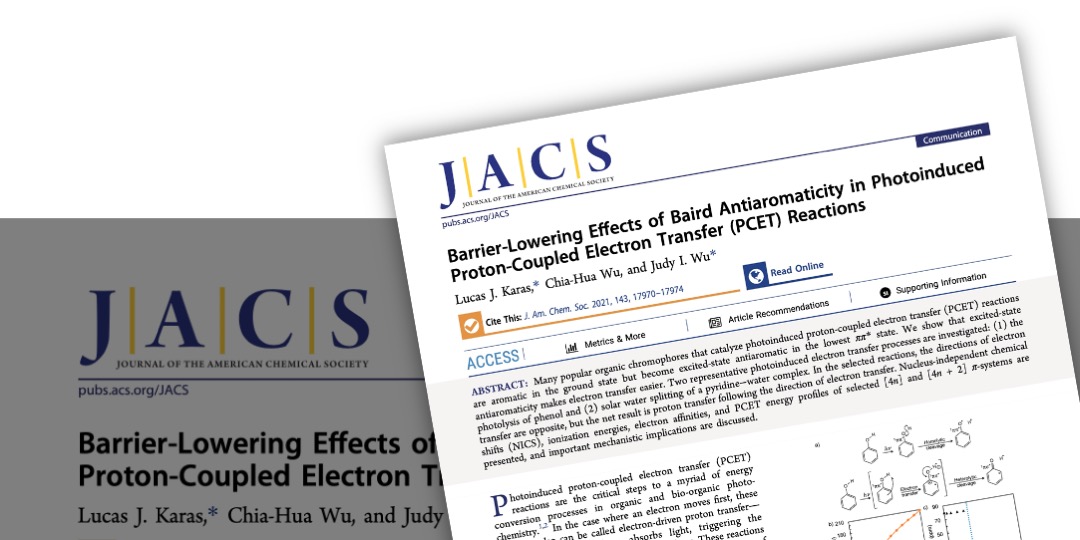
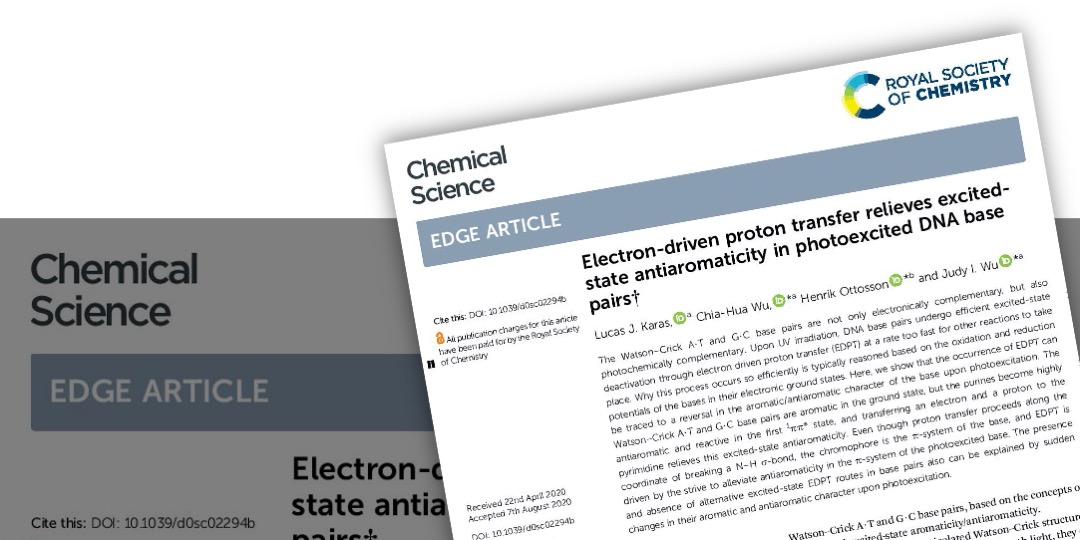
Excited-state proton transfer (ESPT) is a reaction that relaxes the energy of a photoexcited organic compound by shifting the position of a proton. We recognized relief of excited-state antiaromaticity as a driving force and design strategy for ESPT processes in organic, supramoelcular, and biological systems.

Links to selected publications:
J. Am. Chem. Soc. 2021, Chem. Sci. 2020, Proc. Natl. Acad. Sci. 2019.

Aromaticity-Hydrogen Bonding

Despite being treated as largely separate concepts in chemistry textbooks, aromaticity and H-bonding can be coupled to control H-bond association and to modulate the electronic properties of catalytic systems, supramolecular assemblies, and functional organic molecules.

Links to selected publications:
J. Am. Chem. Soc. 2020, J. Am. Chem. Soc. 2019, J. Am. Chem. Soc. 2014.

Gallery

People

Muhammad Khan

PhD student

Ume Salma

PhD student

Francisco Martins

Postdoctoral Associate

Vinicius Martinelli

Postdoctoral Associate

Taveechai (Nui)
Wititsuwannakul

Postdoctoral Associate

Will DeSnoo

Prospective postdoc

Alumni

TPOC Meetings

Spring 2026 Schedule

March 12
Eugene Kwan (Merck)
Academic Collaborations at Merck

April 9
Sabayasachi Chakraborty
(Poranne Group, Technion)
Fusing Functionality: A Computational
Exploration of Heterocycle–Heptalene Hybrids

Will DeSnoo (Tantillo Group, UC Davis)
Kinetic stabilization of Sigma-Allyl Cations

May 7
Turki Alturaifi (Liu Group, U of Pittsburg)
Mapping the Polarity Landscape of Organic Radicals Across Chemical Space


The Theoretical Physical Organic Chemistry (TPOC) meetings are a series of mini-online symposiums created for students and postdocs from research groups around the world to establish interactions and friendships at a critical stage of their career. Each meeting is one hour long, and two students or postdocs from different groups share their research.

We meet on Zoom on the second Thursday every month at CDT 11am.

Judy I. Wu


Judy Wu grew up in the subtropical island of Taiwan. She received her Bachelor's degree in Chemistry in 2004 from Tunghai University, and her PhD in 2011 from the University of Georgia, where she worked with Paul Schleyer. Judy joined the faculty at the University of Houston in 2015 and is currently the Thomas A. Albright Professor of Chemistry. Her research has been recognized with several awards, including the IUPAC-Solvay Young Chemist Award, an Alfred P. Sloan Fellowship, the NSF CAREER Award, and NIH MIRA funding. She is an Associate Editor for the Journal of Physical Organic Chemistry. A computational chemist by training and an organic chemist at heart, her work uses computational insights to guide experimental discovery. Outside of research she plays tennis, makes time to draw every day, and goes on long walks with her dogs.